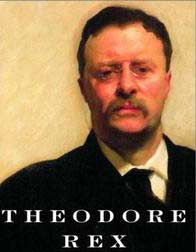
Theodore Rex is the second installment of a three part series on the life of Teddie Roosevelt by Edmund Morris. Following Morris’ Pulitzer prize winning The Rise of Theodore Roosevelt, Theodore Rex examines Teddie’s years as President starting with his journey to Washington after upon learning of the assassination of President McKinley. This well researched account covers in colorful detail Roosevelt’s political brilliance in concluding the Panama Canal Treaty, his tactful negotiations to broker and end to the Russo-Japanese war, his political courage in invoking the Sherman Act and pursuing anti-trust judgements against the most powerful industrial trusts in the land, his Pure Food bill, and finally the environmental legacy Roosevelt left to this country with the establishment of most of the national parks and monuments we enjoy today. Theodore Rex clearly shows why Teddie Roosevelt is considered one of our greatest presidents and well deserves his place at Mt. Rushmore among Washington, Jefferson, and Lincoln.
“This being human is a guest house
Every morning a new arrival.
A joy, a depression, a meanness,
some momentary awareness comes
as an unexpected visitor.
Welcome and entertain them all!
Even if they are a crowd of sorrows,
who violently sweep your house
empty of its furniture,
still treat each guest honorably.
He may be clearing you out for some new delight.
The dark thought, the sham, the malice,
meet them at the door laughing,
and invite them in.
Be grateful for whoever comes,
because each has been sent
as a guide from beyond.”
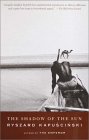
My father first introduced me to the works of Ryszard Kapuscinski through The Emperor, Kapuscinski’s unnerving examination of Emperor Haile Selassie’s rule in Ethiopia told through the eyes of former members of Selassie’s court. With The Shadow of the Sun, Kapuscinski spreads his journalist reach throughout the continent of Africa revealing its mosaic of cultures, histories, tribal worldviews and indomitable geography. Kapuscinski is Poland’s most renowned journalist. First arriving in Africa in 1957, he lived there off and on for 40 years observing countless coups and managing to contract malaria as well as tuberculosis. Unlike most European visitors who kept to the safe, wealthy areas, Kapuscinski wanted to know how everyday people – tradesmen, bus drivers, medical aides – lived. In this book Kapuscinski describes the centuries old conflict between the Hutus and the Tutsis that resulted in the extraordinary genocide the world observed in the 90s. He writes of the fundamental differences in how people of different African tribes view themselves in relation to the rest of the world, and how these differences often lead to tragedy incomprehensible to the Western mind. Also revealing was the history of the former American slaves who founded Liberia in the early 1800s only to enslave the surrounding local population for the next 100 years.
Continue reading →
Years ago I came across this helpful summary of relationship guidelines based on the work of David Schnarch (author of Passionate Marriage).
“Differentiation” has to do with our ability to distinguish between our issues and those of our partners.
It’s so easy to blame others for our own dissatisfaction. We feel a lack in our lives and get upset that others aren’t supplying what is lacking. I’ve noticed especially in relationships this tendency gets magnified.
Here are highlights of steps to take towards creating healthy, well differentiated relationships:
1. Stop blaming your partner. It only makes you sound like a helpless victim. When you close that avenue in your life, many new ones will open. You will start putting your attention on yourself where it will do the most good.
2. Ask yourself about your own happiness. What isn’t working for you? How can you take charge of your life?
3. How are the current relationship issues made worse by you, your attitude, your timing, your way of looking at it, your inability to ask for what you want vulnerably, your defensiveness, your impatience, or your unexamined life?
4. Confront yourself not your partner. This will change your life. Are you living your own integrity? Are you the person you want to be? Are you living up to being the best you?
Continue reading →
I’ve always been curious about astrology. Every year my uncle/godfather prepares my astrological chart and spends an hour going over what Pluto is doing in the 7th house and how Mercury is rising, etc. etc. Given that I don’t know what any of this means, these explanations usually shoot right by me.
A few years ago I began to notice that many of my detail oriented friends happened to be Virgos, and many Virgos I met happened to be neat freaks, so I began to take notice.
Maybe there’s something to astrology after all. In the spirit of exploration, I decided to try out sample reading from Astrology.com and fork over a few bucks for a reading or two. A $12 “Career Path” report yielded the following excerpt:
Continue reading →