
Walter Isaacson’s highly readable Benjamin Franklin: An American Life tells the story of the extraordinary life of our most colorful founding father. One cannot help after reading this book that Ben Franklin would have fit right into today’s urban society. Wonderfully open-minded, witty, curious, practical, and incorrigibly flirtatious, he would have made the most interesting company even today. Reading Isaacson’s book, I was struck not only by Franklin’s accomplishments and his contributions to the success of our revolution and our constitution, but also by his contributions to the set of values that define what is an American.
In Isaacson’s words,
Benjamin Franklin is the founding father who winks at us… He was, during his eighty-four-year-long life, America’s best scientist, inventor, diplomat, writer, and business strategist, and he was also one of its most practical, though not most profound, political thinkers. He proved by flying a kite that lightning was electricity, and he invented a rod to tame it. He devised bifocal glasses and clean burning stoves, charts of the Gulf Stream and theories about the contagious nature of the common cold. He launched various civic improvement schemes, such as a lending library, college, volunteer fire corps, insurance association, and matching grant fund-raiser. He helped invent America’s unique style of homespun humor and philosophical pragmatism. In foreign policy, he created an approach that wove together idealism with balance-of-power realism. And in politics, he proposed seminal plans for uniting the colonies and creating a federal model for a national government.
Continue reading →
Caught this in Sharon Begley’s column in Friday’s Wall St. Journal. (click here for full article, available for a few days). Stanford University’s Robert Sapolsky has observed that when the most aggressive, dominant members of a baboon clan are removed, the culture of the remaining baboons changes to become more peaceful. These changes persist even as new generations come into the clan either from birth or from other clans.
The most recent evidence of culture among animals comes from studies of olive baboons. It stands out because the learned behavior is so at odds with how badly baboons customarily behave.
Baboons tend to be fierce and aggressive, and the “Forest Troop” in Kenya’s Masai Mara Reserve fits the mold. Males fought over everything (grub, girls …) and nothing. But in 1982, the aggressive males began raiding the garbage pit of a nearby tourist lodge, gorging on rotten meat. Almost half of the troop’s males — and all the aggressive ones — died of tuberculosis, leaving, as Stanford University biologist Robert Sapolsky puts it, “a cohort of atypically unaggressive survivors.”
Continue reading →

To my dear friend Steve Peskind,
I just called your home and had a long talk with Bob who told me that you passed away on Thursday. My dear radiant Steve, I don’t think it has quite sunk in yet that I won’t be hearing your bubbling voice or seeing your laughing eyes as you impart your words of playful wisdom. What serendipity it was to meet you so many years ago at one of Elisabeth’s parties – you all dressed in white like a happy little guru – Baba Ganesh. Our sitting in ET’s room and your teaching me a meditation to transform the anger I had over some guy. Do you remember?
Continue reading →
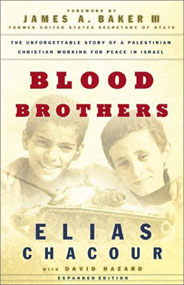
Elias Chacourt is a Melkite Catholic priest and a Palestinian. Blood Brothers is at once the story of Elias’ life growing up by the Sea of Galilee and an impassioned plea for reconciliation between the forces that have torn that area apart during this last century. It is a simple, beautiful, and deeply moving story of one man’s work to heal the conflict in his homeland. The title comes from Elias recalling his father inviting Jewish neighbors in for tea when Elias was a young boy, explaining to the children that the Jews and the Palestinians were “Blood Brothers” as they shared the same father Abraham.
What is so striking to me is the absence of a balanced view of the Israeli Palestinian conflict in what we Americans have been told over the last several decades by our government and the press. What most Americans do not know is that in the late 40s the Israeli zionists forced the Palestinians off of the land on which they and their ancestors had lived for hundreds of years, thus setting off the division and conflict that we live with today. No wonder Palestinian militants are blowing themselves up. They want their land back.
Continue reading →
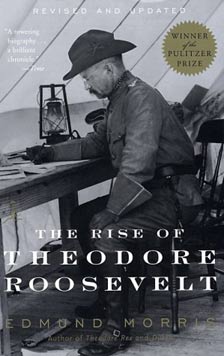
Edmund Morris’ Pulitzer Prize winning The Rise of Theodore Roosevelt is a fast and fascinating read from beginning to end. First published in 1979 Morris interviewed many who knew Teddy well, including two daughters and a son, to paint a vivid picture of the man. The Rise starts with the birth of Theodore to a wealthy New York family, descendents of some of the first Dutch settlers in New Amsterdam. The book follows Teddy through his sickly but precocious childhood, his years at Harvard, his first and second marriages, his entrance into politics as a state assemblyman, his years out west as a cowboy and rancher, his return to politics as a federal civil service reform commissioner, his return to New York as a reform police commissioner, back to Washington as Assistant Secretary of the Navy, his bravery as the colonel leading the regiment of “Rough Riders” to victory in Cuba, his election as Governor of New York, and finally his election as Vice-President of the United States. All accomplished before the age of forty-five.
Continue reading →
When my brother John first told me about Why Catholics Can’t Sing, I nearly fell off my chair laughing. Someone had actually written a book about this phenomenon? Every since I started going to church again after a several year absence I have been complaining to all who would listen about the atrocious music sung in Catholic masses these days. It’s not that Catholics can’t sing, it’s that they don’t. Who wants to sing unremarkable music? I love to sing and I rarely do in mass. The reason is that most of the music is some 70s holdover sappy pop folk stuff that hurts my ears to hear, especially when accompanied by guitar strummers. Whatever happened to the music I loved as a little girl in the early 60s? Faith of our Fathers, O Santissima, Holy God We Praise Thy Name? When I asked my mother why our music was so bad, especially compared to that of the Episcopalians, she replied that 1) we believe that the music should not detract from the mass, and 2) that great church music sounds too much like Protestant music and we need to be different. Not that she believes either of these reasons to be sufficient justification for bad music, it’s just that these are the reasons that are typically given.
Detract from the mass? What is more of a distraction than poorly sung bad music? Try to be different from the Protestants? Why? We have the most beautiful, glorious music in our Catholic heritage and no one is growing up knowing it.
Continue reading →