A couple of summers ago I had the great fortune to be able to help a friend of mine a few hours a week with her Montessori pre-school. As the eldest of six kids growing up, loving children and not having my own, this experience was a welcome break from my usual high-tech reality. What so amazed me was that each of these 20 or so 3 and 4 year olds was a vast and extraordinary universe in and of him and herself. All of humanity’s emotions, joys, despairs, and conflicts were played out every day in our little classroom.
My favorite student (and as much as teachers try otherwise, we all have our favorites) was a 4 year-old girl named Zoe. She sparkled with intelligence and enthusiasm and displayed unusual grace and maturity for her age. Everyone loved Zoe. So I was surprised one day when, during lunch, she asked to sit next to another student, Matthew (not his real name), and he ignored her, not letting her in. He continued to ignore her that day, even when Zoe asked him point blank, “Matthew, my feelings are hurt that you won’t play with me. What did I do wrong? Why won’t you play with me?”
Continue reading →
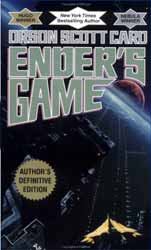
Winner of the Hugo and Nebula Awards, Ender’s Game by Orson Scott Card revolves around a young boy, Ender Wiggin, who is selected to train to become a fleet commander to protect earth from an alien invasion. The training takes place at a distant Battle School in space where the young and brilliant Ender is repeatedly pushed to his limits to mold him into what he is needed to be, to become the next commander and win the war against the invaders.
I’ve read Ender’s Game 5 or 6 times in the last 15 years, and recently listened to the audiobook. I honestly think that Ender’s Game is the best piece of science fiction I have ever read. Card is unusual as a science fiction writer in that he delves deeply into the psychology of his main characters and their complex inter-relationships. Nothing is as black and white as it may seem. There is goodness and honor in Ender’s enemies as well as a willingness to manipulate and kill in Ender. Ender is constantly faced with hard choices upon which his survival and the fate of the planet depend.
Continue reading →
Note to self: use more semi-colons.
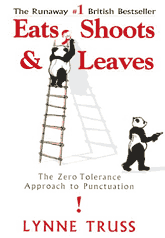
Lynn Truss has written a delightful best-seller on the art of using commas, apostrophes, and semi-colons in her Eats, Shoots & Leaves: The Zero Tolerance Approach to Punctuation. After reading this book all I can think of is that I need to use semi-colons more often. Eats, Shoots & Leaves is both a useful guide to punctuation (primarily from a British perspective) and a witty and humorous rant against the declining use of proper punctuation in our culture. Ms. Truss frequently delves into the historical roots of many of the punctuation and type formatting standards we take for granted today.
How could a book on punctuation make it to the best seller list and stay there for… how many months has it been? One reason is by being well written and entertaining. Another reason is that those of us who read books also often like to write. Since the dawn of email and the Internet we’ve been writing much more than we would ever have expected to. As such, many of us are on the one hand appalled by the lack of proper punctuation populating the emails of those born around the same time as the personal computer, and on the other hand trying to remember what exactly those rules were that we learned so long ago. Eats, Shoots & Leaves appeals to us for both reasons; Truss lambasts the awful punctuation she sees daily while gently explaining the guidelines for doing it right. (I did it! I used a semi-colon in a sentence!)
Continue reading →
There are only 4 questions of value in life, Don Octavio:
What is sacred?
Of What is the spirit made?
What is worth Living for? and
What is worth Dying for?
The answer to each is the same: only Love!
Don Juan DeMarco to Don Octavio
in the film Don Juan DeMarco
To dare is to lose one’s footing momentarily. To not dare is to lose oneself.
Soren Kierkegaard
Chess, which exists predominantly in two dimensions, is one of the world’s most difficult games. Three-dimensional chess is an invitation to insanity. But human relationships, even of the simplest order, are like a kind of four-dimensional chess, a game whose pieces and positions change subtly and inexorably between moves, whose players stare dumbly while their powerful positions deteriorate into hopeless predicaments and while improbable combinations suddenly become inevitable. To make matters worse, some games are open to any number of players, and all sides are expected to win.
Robert Grudin
From Time and the Art of Living